
"The Papers"

Today I cleared out files that I’ve carried for over 10 years.
Included in the stack of papers now sitting on my dining room table — I couldn't quite yet bring myself to throw them away — are: my Standard Form-86 when entering the Naval Academy as a Plebe; my medical screening forms before military duty, during 2/C year, and before leaving for grad school; engineering papers and notes from sophomore year of college; reams of notes on lined notebook paper and yellow graph paper with green grid lines from my Control System engineering courses; several documents and records from the Marine Corps; application requests for movement of household goods from England to the United States; and all the notes from my Desktop Manufacturing course, the one taught by the highly idiosyncratic and incredibly brilliant Brad Bishop.
One paper boldly announces PLEBE TEXTBOOK ISSUE BOOKS in all caps across the top of the page. Below it are listed ten items, each with a blue checkmark to the left of the typed writing, no doubt to delineate that I did, in fact, receive Ships and Aircraft of the U.S. Fleet, The Bluejackets Manual, Basic Keelboat, Navigation Rules, and A Message to Garcia, among others. I have signed the bottom in a bold but unbalanced script and have written “141386” above the line reserved for ALPHA NUMBER.
Looking back, those blue checks represent more than a record, they represent all the authority of an institution that I once feared and loved. They were meant to be the checks, literally, on my anticipated incompetence, because one day when I needed one of those books, Navigation Rules for example, and couldn’t find it and said as much to this or that incarnation of the institution’s authority, then they would point to this paper and those ten definite and incontrovertible blue checks and say, “This is your fault. Do you see those blue check marks? It means you were given the book, and now you’ve gone and lost it and you’re gonna pay.” Of course, payment might have meant cash, but at that time could also mean a host of other things — public shaming and physical punishment often among them.
Behind this record is a whole stack of quizzes and exams from Statics, one of my first engineering courses. A universal course that as one textbook now puts it ‘…is the gateway into engineering mechanics, which is the application of Newtonian physics to design and analyze objects, systems, and structures with respect to motion, deformation, and failure.’ The piece of paper on the top of the pile details GUIDELINES FOR PRESENTATIONS OF FREE BODY DIAGRAMS (FBD) which gives seven rules in an authoritative tone:
“...straight edges must be used to construct all FBD, associated force vectors, and frames of reference,” says Rule 1.
“Your solution must include a frame of reference,” adds Rule 5.
“Position forces on the FBD such that they do not create confusion,” lectures Rule 6.
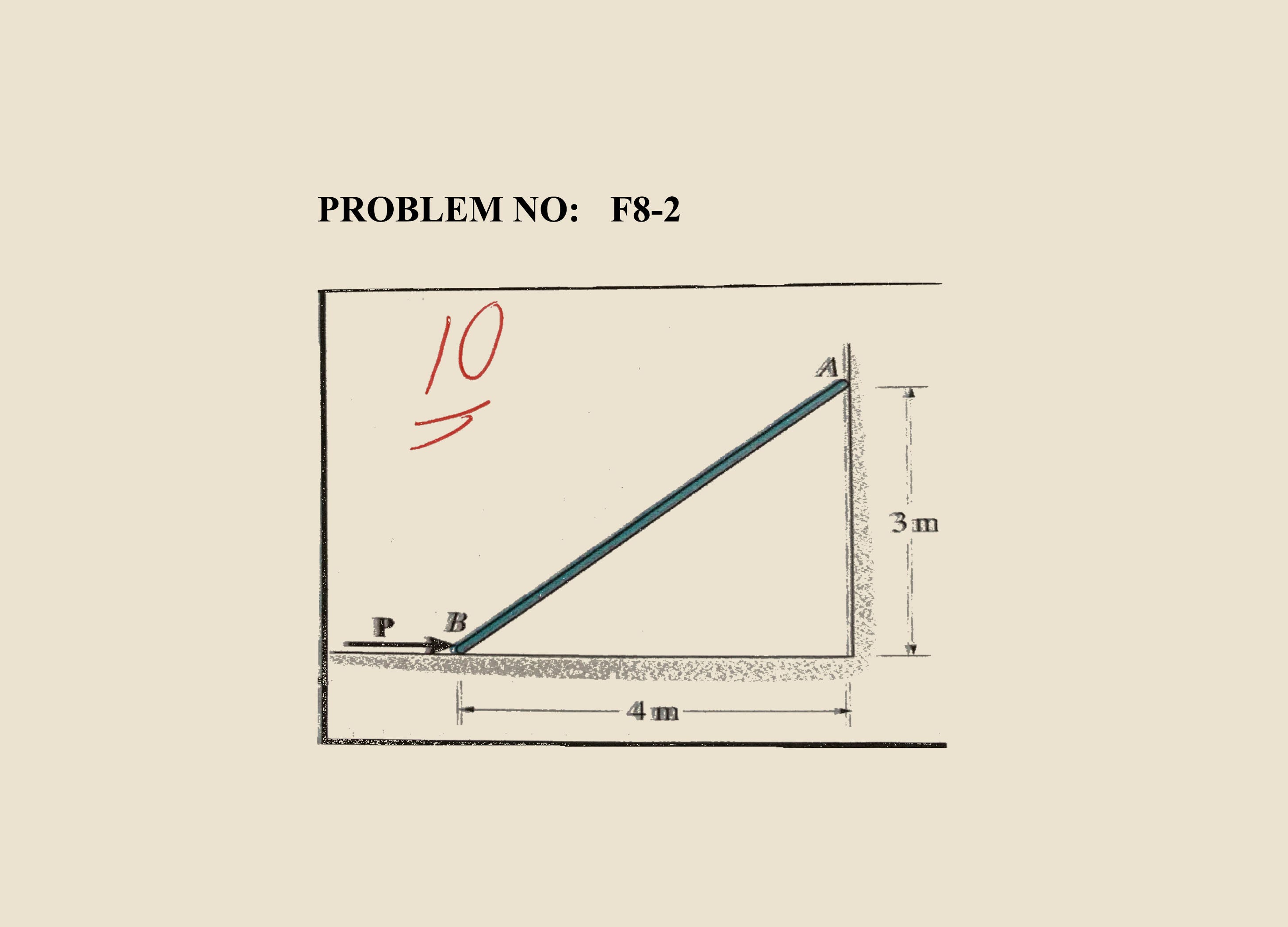
Beneath this is a paper labeled PROBLEM NO: F8-2, and it presents an image of a bar leaning against a wall. The bar is labeled AB, and an arrow labeled P is pushing against the point on the bar nearest the ground. Given several assumptions — that µ at A=0.2, B is smooth, the bar is at rest, and the mass of the bar is 30kg — I was supposed to determine on this particular November 16th the force P that prevents the bar, AB, from sliding.
The starting equations are ∑M=0, meaning that the sum of the moments are equal to zero, and ∑F=0, meaning that the sum of the forces acting on the bar are zero, a la the bar is at rest.
In neat, perfectly ordered handwriting I redrew the diagram (clearly following the GUIDELINES FOR PRESENTATIONS OF FBDs), labeled all parts, showed all forces, solved the equation and boxed the final answer of P=155 N – as we were trained to do in all our engineering courses in those days.
First I’m struck by the assured precision. I wrote in pencil, but there are no eraser marks. Like one moving about his own house, I proceeded confidently, knowing each squeaking stair or false floorboard and avoiding those missteps. Veni, vidi, vici. The professor concurred, awarding me a 10, underlined twice. There was nothing left to chance. Knowing myself at the time I probably studied for this quiz by doing similar problems dozens of times.
And then a second thing strikes me. Why have I carried these pieces of paper around for over a decade? When leaving college I wanted little to do with engineering. I actively avoided taking the Fundamentals of Engineering, or FE, Exam, partly from fear and partly because I knew I wouldn’t be a professional engineer. But before me is a totem I carried for more than 10 years as some sort of lucky charm, like those who wear crosses or carry garlic to ward off vampires. But what vampire was I trying to avoid?
The final thing that strikes me about the big pile of papers stacked neatly on my dining room table are the big red “10s”, underlined twice. And that gives me a clue as to why I kept the papers all these years, what monster I attempted to ward off with the rudimentary magic of hoarding. I was trying to remind myself of my self-worth, and I attached so much of it to this — these fractions written in red ink — that added up over time to give me a quantifiable grade that I could point to when I doubted myself or when I was doubted by others.
I look back now at these feeble efforts to quantify my self-worth and am saddened. These papers seem the desperate plea of a person trying to hold a world together that was dynamic and moving, spinning and changing far outside his control. But he—but I—wanted it static and stable.
I took much harder courses than Statics during my time in college: Differential Equations and Thermodynamics come to mind, but I kept none of those materials as a record. Why did I hang on to the papers from arguably the easiest engineering course in the curriculum? Statics was clean, easy, straightforward. In every problem, even pesky variables like friction were reduced to a calculable, constant coefficient so that the problem always worked out, the forces always summed to zero, the bar AB, weighing 30kg, never slid and fell.
I realize that’s how I lived my life in my college years and during my 20s, like that bar, trying to stabilize myself by neutralizing the forces around me, suspending myself in a perfect equilibrium. I rarely took risks. I regulated relationships. I originated reasons for why I couldn’t take a trip, try a new experience, or reveal more of myself to others. I reduced uncertainty by reducing the variables to constant, calculable coefficients.
There have been several times in the last ten years where I tried to throw these papers away, but I couldn’t bring myself to do it. I still craved the talismanic properties of courage and self-worth these grid-lined sheets transmuted to me. If I could have seen more clearly I would have understood how little these artifacts of my intelligence did to protect me from the world. These translucent pieces of paper stacked high enough, I thought, would be an armor to shield me from the vicissitudes of existence. But did they really? Did they actually do me any good? Maybe their mere presence hindered me longer than necessary.
In the end they possessed no magic nor charms nor any protective properties. They were powerless as relics. But that was maybe never the point. Planar trusses, area moments of inertia, vector cross products, I saved them all and carried them through the years to discover I no longer need them. Instead they served as a vessel for carrying my recollection across more than a decade of time and experience, and that perspective, that transportation back to another time and place, to a different-but-the-same me, shows me that I can change, that I can grow up, that I can adapt, that I can succeed.
It’s possible that without knowing it I kept them all these years because they hadn’t yet fulfilled their purpose, and now lying strewn across my dining room table after traveling across three continents they finally have done the thing I kept them for so many years to do.
The Bar AB won’t stay at rest. And that’s a good thing.